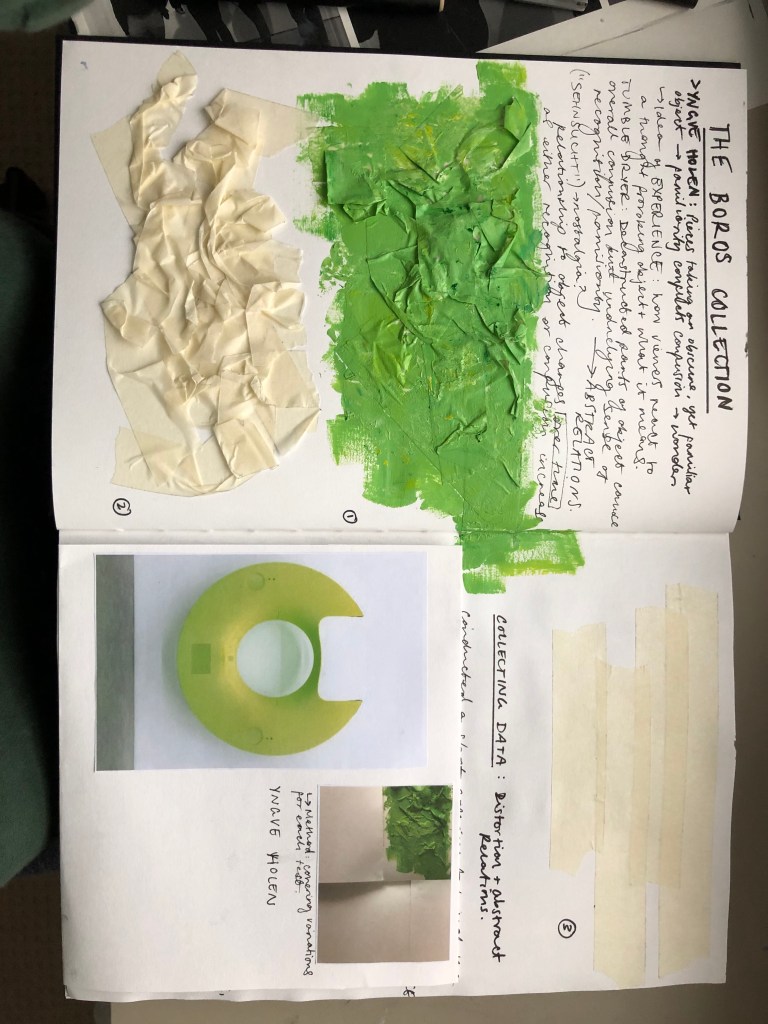
Having looked into language in a gallery setting and the effects it has on the experience, I decided to look into human experience in itself. I was inspired by Yngve Holen’s exhibit in the Boros Collection, which plays with the boundaries of familiarity in objects, and pushing alterations of them.

I liked the idea of being able to experience an object, as well as this oddly familiar object being a tool for experience in a group, as different people had different levels of familiarity with the piece. Some felt complete absence of connection to the object, while others were able to identify it as an MRI machine relatively quickly.
This inspired me to test the different experience someone has with an object based on its form, or different levels of alteration. I conducted a short experiment with masking tape, a fairly familiar object, and timed my family’s identification of this at each level of distortion of the object.
- Misshapen with unnatural colour applied
- Misshapen
- Most familiar form
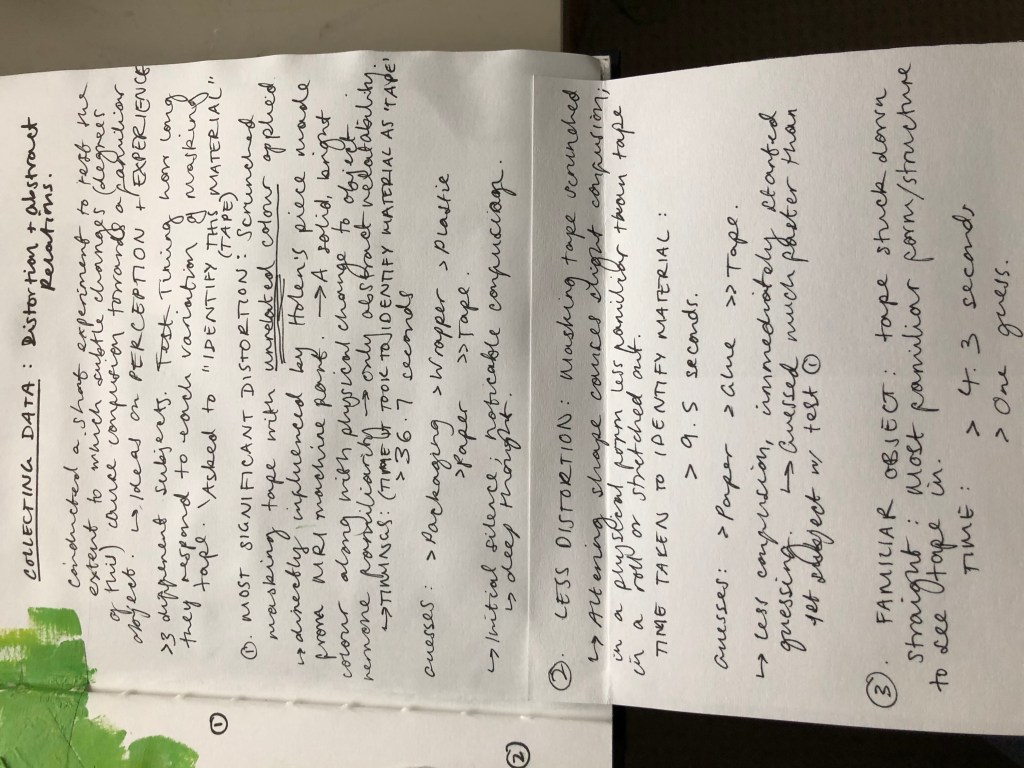
I found the results to be, as expected, proving of the significance of distortion of an object in our familiarity with it. What I found to be most interesting was the high levels of confusion found in the first test (most alterations to the masking tape) that went with the task I presented. Alongside taking a long time to identify the masking tape, the subject in the first test had a clearly different experience while trying to guess: they were much more silent and confused. This raises more questions about the boundaries of difference in human experience, and is something I would like to look into more.
 Sophia Tate